Preprint · arXiv 2610.01739
Fixed-point neural samplers on discrete spaces
Introducing DIG-IN, the Discrete Gibbs Iterative Neural Sampler
* Equal contribution. † Equal supervision.
Overview
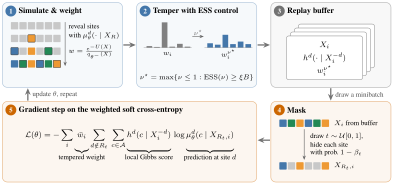
Sampling from a discrete distribution known only up to its normalizing constant is hard. MCMC mixes slowly across energy barriers, and existing discrete neural samplers tend to collapse onto a single mode. DIG-IN trains a masked diffusion sampler from density evaluations alone, with no training data.
Each iteration draws configurations from the current model, tempers their importance weights to a target effective sample size, and fits the model with a weighted cross-entropy. The labels in that loss are Gibbs labels: the normalized distribution over single-site changes of a configuration, a discrete analogue of the score. They give a strong learning signal and keep the sampler from collapsing onto one mode.
- Ising & PottsThe only method in our comparison that covers every mode in the ordered phase while also giving accurate ln Z.
- AmortizedOne sampler conditioned on (β, h), on lattices up to D = 2500 sites.
- AlloysRecovers the phase diagrams of Ag–Pd and Cu–Au from a single sampler conditioned on (T, Δμ).
- PeptidesA Boltzmann generator on binned coordinates of alanine dipeptide and tetrapeptide, trained from the energy alone, with no molecular-dynamics data.
- Free energiesA learned bridge recovers the solvation free energy of alanine dipeptide to within 0.01 of BAR on the molecular dynamics of both states, from samples of one state and the energy of the other.
- RLAs a binned policy for continuous control, the highest final return among the Gaussian, diffusion and flow policies we compare against on 20 DeepMind Control tasks.
Alloy phase diagrams
For Ag–Pd and Cu–Au, a single sampler is conditioned on temperature T and chemical-potential difference Δμ over a DFT-fitted cluster expansion. Its free-energy estimates give the phase diagram through a common-tangent construction. Here we point into regions of that diagram and watch the sampler place atoms on the fcc cell until the structure of the phase appears.
Solid lines are the boundaries DIG-IN predicts, dashed lines the reference. Each marker sits at the composition of the structure shown. The cell is periodic and is drawn as a 4 × 4 × 4 block of cubic fcc cells, so each site appears about twice. Drag the block to rotate it.
Amortized sampling across temperature and external field
We train a single DIG-IN model on the 50 × 50 Ising model and another on the 24 × 24 three-state Potts model, each conditioned on the inverse temperature β and an external field h. The film points at conditions on the training grid and replays how the sampler builds a configuration there, revealing one site or a small group of sites per network call.
Every trajectory is a draw from the trained checkpoint, recorded call by call. Grey cells are still masked. Outlined cells were revealed in the most recent calls. Each thumbnail is one draw at its grid point; at the points the film visits, it is the draw being replayed.
Discretized Boltzmann generators
Boltzmann generators sample the equilibrium distribution of a molecule with a generative model of exact likelihood, so that importance weights remove the remaining bias. We cut every coordinate of alanine dipeptide (22 atoms) and alanine tetrapeptide (42 atoms) into bins, in internal coordinates, and train DIG-IN from the potential energy alone. A uniform point inside each bin makes a draw continuous with an exact density. The film replays draws of the trained models network call by network call and compares two million draws per run with long molecular dynamics.
Every structure is a draw of a trained checkpoint, recorded call by call; still-masked coordinates are drawn at the network's most likely bin. The Ramachandran surfaces show ln p(φ, ψ) on 60 × 60 cells, with the three seeds pooled. Drag a molecule to rotate it.
Free energy estimation
DIG-IN's bridge learns a pair of time-reversed CTMCs between two Boltzmann distributions, from samples of the first and the energy of the second. On FEAT's alanine dipeptide tasks it carries molecular-dynamics frames from vacuum into implicit solvent (ALDP-S), and from one conformational state across a barrier into another (ALDP-T). The weights of the paths give the free-energy difference.
The paths start from held-out MD frames and use the trained bridge of one seed. The estimates use one path per MD frame, about 250k, for each of three seeds. Drag the molecule to rotate it.
Maximum entropy reinforcement learning
In maximum entropy reinforcement learning, the improved policy at every state s is the Boltzmann distribution of the soft action value, π(a | s) ∝ exp(Q(s, a)/τ). Learning the policy is thus an amortized sampling problem over states, whose energy is a learned critic. Most policies for continuous control represent the action directly, as a Gaussian, diffusion or flow model. We instead cut every action dimension into 64 bins and use DIG-IN's masked denoiser, conditioned on the state, as the policy, trained on Gibbs labels read from the critic.
20 continuous control tasks of the DeepMind Control suite in MuJoCo Playground
Citation
@article{he2026fixedpoint,
  title   = {Fixed-point neural samplers on discrete spaces},
  author  = {He, Jiajun and Blessing, Denis and Cheng, Mouyang
             and Du, Yuanqi and Domingo-Enrich, Carles},
  journal = {arXiv preprint arXiv:2610.01739},
  year    = {2026}
}